Español
 English


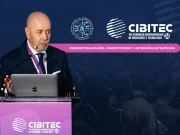
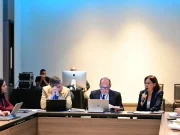
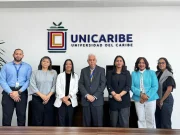
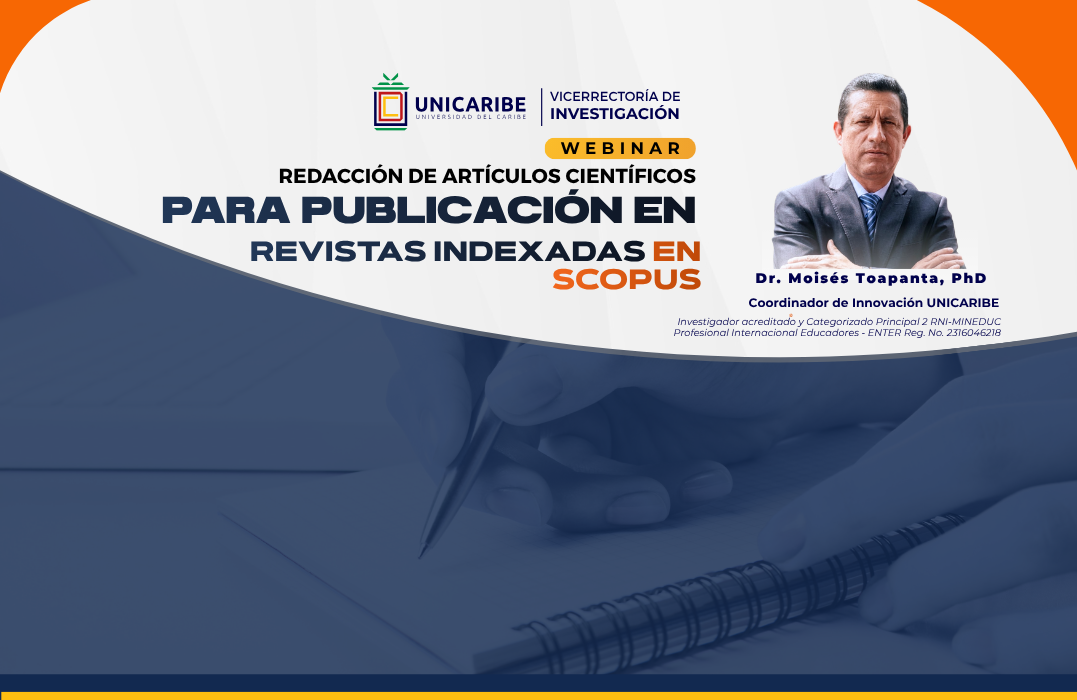
As part of institutional efforts aimed at strengthening research, innovation, and scientific output, the University of the Caribbean (UNICARIBE), through the Office of the Vice Rector for Pedagogical Innovation and Educational Model (VIPME) and the Office of the Vice Rector for Research, hosted the webinar “Writing Scientific Articles for Publication in Scopus-Indexed Journals, ” with the aim of helping participants develop the skills needed to write and publish scientific articles in indexed academic journals. This initiative was carried out under the leadership of Dr. Clara Elisa Tapia Nin and Julián Camilo Bermúdez Peña, who head both areas.
The event took place on Wednesday, September 16, 2026, from 7:00 p.m. to 9:00 p.m., online, and was led by Dr. Moisés Toapanta, Innovation Coordinator at VIPME, who holds a Ph.D. in Information Technology, is a Principal Investigator Level 2 at RNI-SENESCYT-MINEDUC, an International Educator Professional with ENTER, and a reviewer for CEDIA, CACES, and IdeaRium. He also serves as a director of research projects, has 118 scientific publications indexed in Scopus and Web of Science, and co-supervises doctoral dissertations.
During the webinar, participants discussed key aspects related to structure, scientific quality criteria, publication guidelines, strategies for visibility and acceptance, the use of Artificial Intelligence (AI), as well as fundamental elements to consider when preparing research for publication in Scopus-indexed journals. The event was aimed at researchers, faculty, students, and other members of the academic community interested in strengthening their skills in scientific communication and academic publishing.
The event attracted 378 registered participants and recorded 133 certificates of participation downloaded, in addition to a peak concurrent attendance of 124 people during the event. These figures help document the event’s reach and the levels of participation observed in the virtual event, without equating the number of registrants with the total number of attendees.
Participants came from various countries and institutions of higher education, including the Dominican Republic, Ecuador, Spain, Mexico, Peru, Chile, Argentina, Panama, Colombia, and Venezuela, among others. The geographic diversity of the participants reflects the national and international scope of the call for applications and the interest generated by a topic related to strengthening research and scientific publication skills.
Throughout the webinar, participants demonstrated interest and receptiveness, which underscores the importance of continuing to create opportunities for specialized training in scientific research and communication. In light of the positive response received, we are considering holding a second part of the webinar to build on the topics covered and delve deeper into the processes involved in preparing scientific manuscripts for submission to indexed journals.
As part of the efforts to recognize participation, a free download of the Certificate of Participation was made available. By the end of the event, 133 certificates had been downloaded, and this figure serves as a verifiable indicator of the participants’ engagement.
Conclusion
The webinar “Writing Scientific Articles for Publication in Scopus-Indexed Journals” served as a forum for training and academic development aimed at strengthening the culture of research and the capacity to generate and disseminate scientific knowledge.
The level of participation—both in terms of the scope of the call for applications and the geographic diversity of the participants—demonstrates interest in initiatives aimed at strengthening research and scientific publication skills. In this regard, the experience serves as a benchmark for continuing to develop specialized training programs that contribute to strengthening the scientific output of the academic community at the University of the Caribbean (UNICARIBE).
Author:
Dr. Clara Elisa Tapia – Vice Rector for Pedagogical Innovation and Educational Model