Español
 English


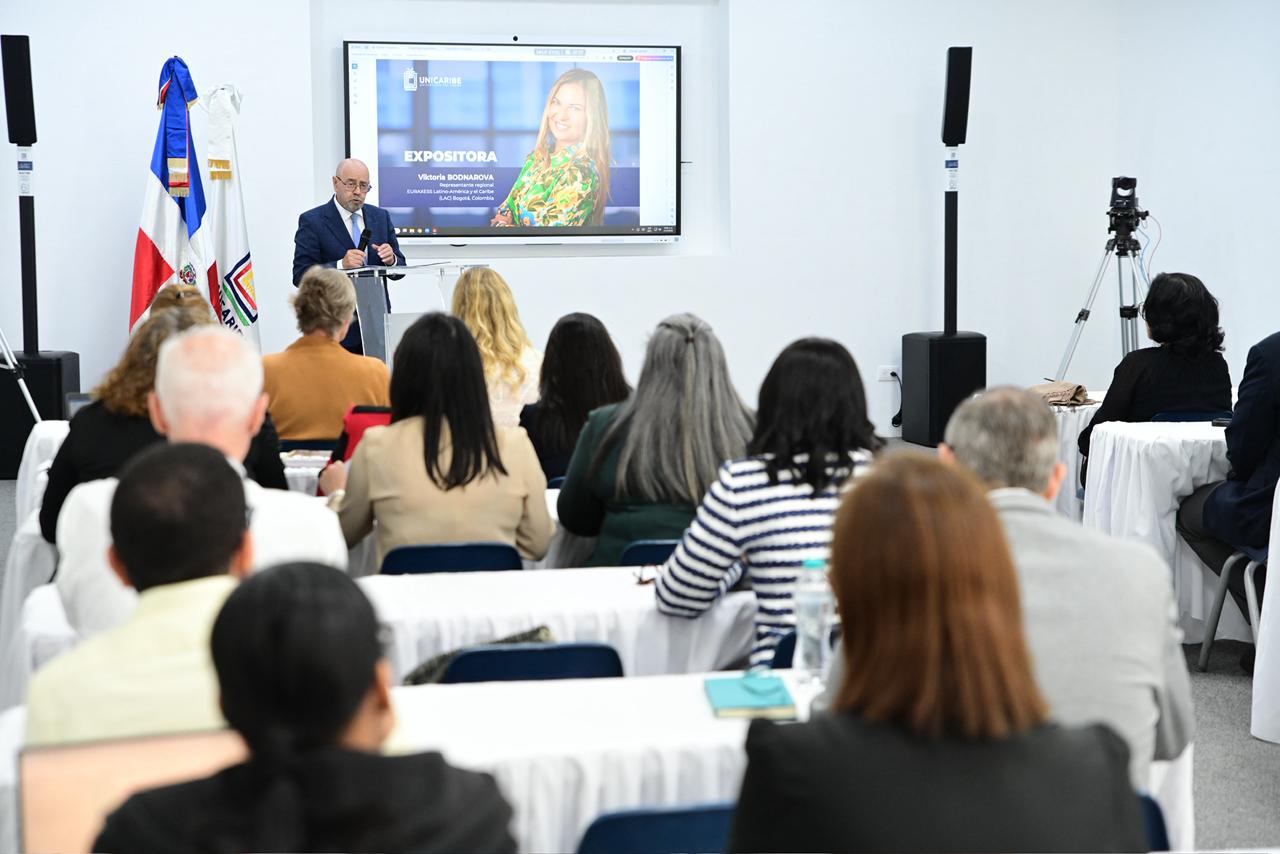

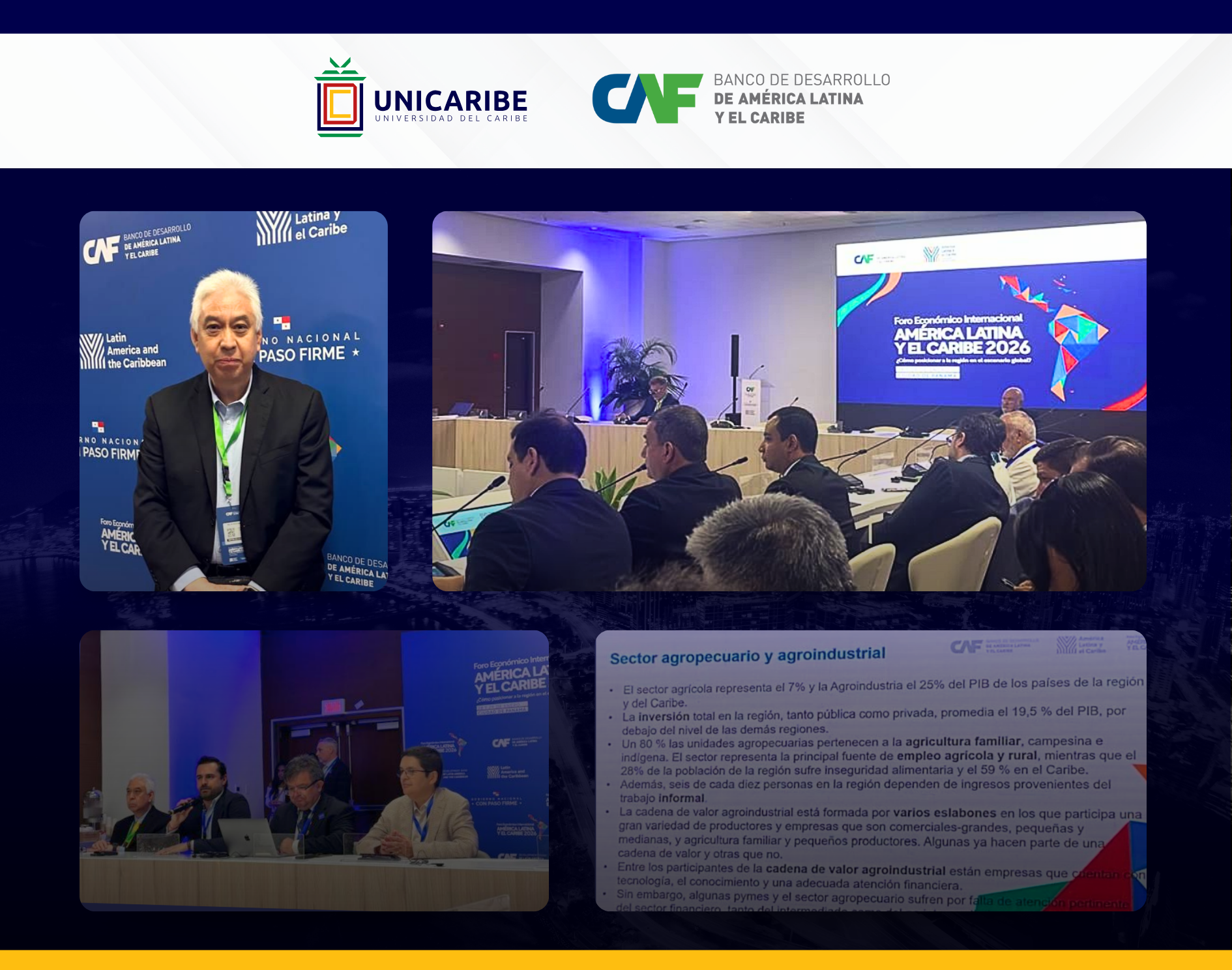
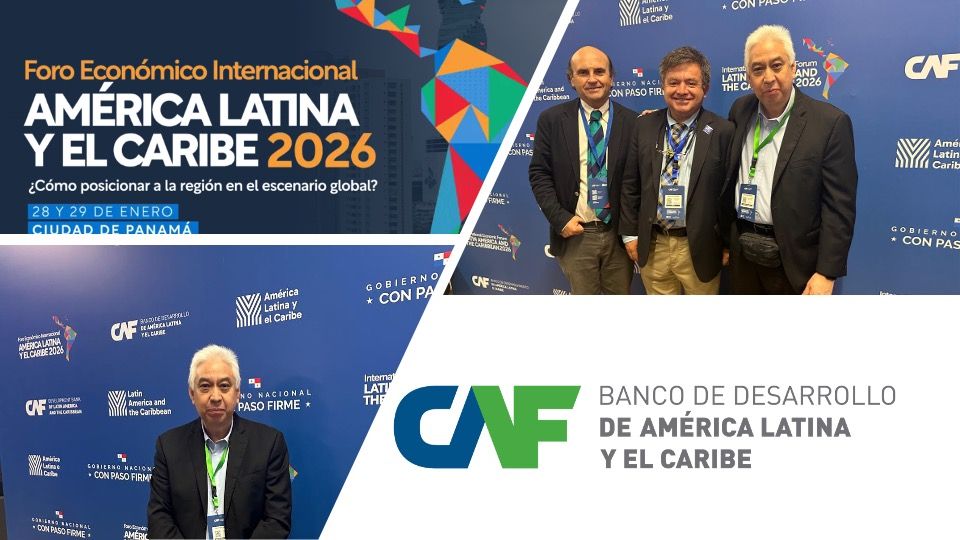
Santo Domingo, Dominican Republic. – The University of the Caribbean (UNICARIBE) participated in the International Economic Forum Latin America and the Caribbean 2026, organized by CAF – Development Bank of Latin America and the Caribbean, held in Panama from January 27 to 30, 2026. This meeting is considered the main forum for economic dialogue in the region and brought together more than 6,500 leaders from 70 countries, including heads of state, multilateral organizations, the private sector and academia.
Within the framework of the forum, the Rector of UNICARIBE, Ph.D. Ricardo A. Ramírez-Mendoza, was invited as an expert panelist in the dialogue entitled “Intellectual Property towards 2030 in the era of Artificial Intelligence: an engine of competitiveness for Latin America and the Caribbean”, focused on the role of innovation, technology transfer and public-private cooperation for regional development.
The panel aimed to analyze how the modernization of Intellectual Property (IP) systems, in a context marked by artificial intelligence and emerging technologies, can boost trade, attract investment and strengthen the economic prospects of the region, as well as promote collaboration between the public, private and multilateral sectors.
Enrique Zapata, CAF’s Director of Digital Transformation; Dr. Jorge Rojas, University of California, Davis; Dr. Carlos Monsalve, Vice Rector of ESPOL (Ecuador); and Fabián Xavier Castillo, President of FECOBA, participated along with Rector Ramírez-Mendoza . The moderator was Dr. Jorge Rojas, who presented a global overview of IP linked to the bioeconomy, genetic resources and ancestral knowledge.
Proposal of Rector Ricardo A. Ramírez-Mendoza in the face of the irruption of Artificial Intelligence in higher education:
The Rector of the University of the Caribbean (UNICARIBE), Ph.D. Ricardo A. Ramírez-Mendoza, pointed out that universities in Latin America and the Caribbean currently face the challenge of transcending their traditional role in the face of the irruption of artificial intelligence. Although the training of talent and scientific research continue to be fundamental pillars, there is still an institutional inertia that prioritizes the almost automatic dissemination and publication of research results, without prior reflection on intellectual property.
In this context, the Rector emphasized that for knowledge to become a true social good, it is essential to move towards a culture of technology transfer that protects and values intellectual creation before its mass dissemination. He also warned that the acceleration of design and research cycles driven by artificial intelligence has rendered obsolete many existing regulations, which were conceived for different technological environments.
Finally, he stressed that university policy cannot be static and must harmonize with these disruptive changes. From his point of view, artificial intelligence should not be seen as a threat, but as a strategic ally that has a transversal impact on the three substantive functions of academia: teaching, research and links with society.

During the panel, Fabián Xavier Castillo, president of FECOBA, provided the perspective of micro, small and medium-sized enterprises (MSMEs) in the era of artificial intelligence, stressing that intellectual property should be an instrument to promote foreign investment, innovation and digital transformation in Latin America and the Caribbean. He stressed that MSMEs, which represent more than 98% of the region’s business fabric, require IP frameworks that facilitate technology transfer and its integration into productive processes.
In this context, he highlighted the ACTIVA 4.0 – Industrial MSMEs program, in which UNICARIBE actively participates, as a triple helix initiative aimed at strengthening the competitiveness of the Dominican productive sector through innovation, digitalization and university-industry linkages.
Towards productive intelligence with regional impact.
In his closing remarks, the Rector of UNICARIBE, Dr. Ricardo A. Ramírez Mendoza, emphasized that one of the main challenges in Latin America and the Caribbean is not the lack of talent or ideas, but the difficulty of transforming knowledge into positive social impact. He pointed out that innovation is more likely to occur when there are clear mechanisms for technology transfer, when intellectual property rights are recognized from the initial stages and when joint projects are structured with well-defined objectives, times and responsibilities.
In this sense, intellectual property is consolidated as a strategic instrument for licensing technologies, promoting science-based ventures, developing solutions to productive and social challenges, and scaling innovations from academic spaces to the market and the territory, acting as an effective bridge between research and its practical application.
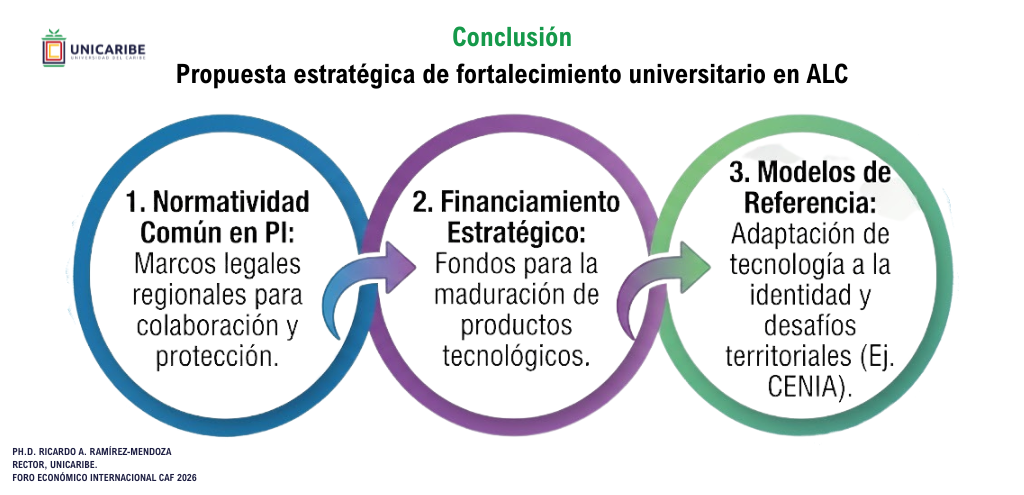
The panel’s conclusions underscored the need to strengthen the relevance of the region’s universities based on three priorities: to move towards common intellectual property regulations, to promote strategic financing schemes aimed at the maturation of technological products, and to adopt successful reference models adapted to the identity and territorial challenges of Latin America and the Caribbean.
References:
– University of the Caribbean. (n. d.). ACTIVA 4.0: Towards a sustainable collaboration of the triple helix and the transition to Industry 5.0. https://noticias. unicaribe.edu.do/activa-4-0-hacia-una-colaboracion-sostenible-de-la-triple-helice-y-la-transicion-a-la-industria-5-0/
– Ramírez Mendoza, R. A. (n. d.). Intellectual property, innovation and university-industry alliances [Publication on LinkedIn]. LinkedIn. https://www.linkedin.com/posts/ph-d-ricardo-a-ramirez-mendoza-35b844316_propiedadintelectual-innovaciaejn-alianzasuniversidadindustria-activity-7422677147699286016-X6b9
Authors:
Ph.D. Ricardo A. Ramírez-Mendoza – Rector of UNICARIBE.
Abg. María José Brito, Coordinator of the Bachelor’s Degree in Environmental Management and Energy Resources – Universidad del Caribe (UNICARIBE).